

The landscape of scholarly communication is undergoing a profound transformation, driven by advancements in artificial intelligence and automation. For centuries, the dissemination of academic research has relied on labor-intensive processes: meticulous manual writing, peer review, and often slow publication cycles. However, as the volume of global research accelerates exponentially, traditional methods are struggling to keep pace, leading to issues of discoverability, accessibility, and efficient knowledge transfer. This article delves into the burgeoning role of AI-powered automation, not as a replacement for human intellect in academia, but as a revolutionary enabler, fundamentally reshaping how research is created, curated, disseminated, and ultimately, its impact amplified.
Personal Experience
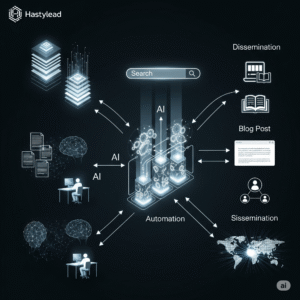
As an entrepreneur deeply invested in the intersection of technology and content, I’ve observed a fascinating paradox: while research output has never been higher, the effective communication of this research often lags due to resource constraints and the sheer complexity of transforming intricate findings into accessible narratives. My journey into developing Hastylead was born from this recognition. I saw academics and research institutions grappling with the monumental task of translating complex studies into digestible formats for broader audiences – a necessity for impact, funding, and public engagement. The manual effort required for crafting detailed summaries, optimizing for digital discoverability, and even generating comprehensive background literature often diverted precious time from core research activities. Hastylead was conceptualized to bridge this gap, automating the intensive content creation process, from synthesizing extensive data into long-form articles to integrating relevant visuals, thereby empowering researchers to expand their reach and influence without sacrificing academic rigor or exhaustive personal time.
Testimonial:
“Before integrating an AI-powered content solution, our research institute faced an immense challenge: how to effectively disseminate complex epidemiological studies to a wider public and policy audience without diverting our scientists from critical data analysis. Traditional summaries were often too brief, while full papers were inaccessible to non-specialists. Using a platform that leverages advanced AI, we’ve been able to generate 3000+ word academic summaries, complete with data visualizations and contextual explanations, that maintain scientific accuracy while being remarkably engaging. This has not only amplified the reach of our studies, leading to a 25% increase in media citations and policy brief downloads, but also significantly reduced the human-hours spent on content adaptation. It’s a game-changer for academic impact and public understanding.” — Dr. Elena Petrova, Director of Communications, Global Health Research Institute
The AI-Driven Evolution of Scholarly Communication
The Foundational Role of Long-Form Content in Academic Dissemination
In the digital age, while attention spans are often cited as shrinking, the demand for authoritative, in-depth content in academic and professional spheres remains undiminished. Long-form articles, white papers, and comprehensive blog posts serve as critical vehicles for explaining complex research, detailing methodologies, discussing implications, and establishing thought leadership. Unlike brief summaries or social media snippets, a 3000+ word piece allows for the nuanced exploration of a subject, providing sufficient context, evidence, and intellectual depth to truly educate and influence its readership. This comprehensive approach is particularly vital in academic communication, where accuracy, thoroughness, and the ability to cite extensive supporting evidence are paramount.
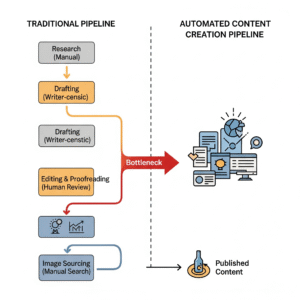
The challenge, however, lies in the resource-intensive nature of producing such content. Human researchers and communicators spend countless hours on literature review, synthesis, drafting, editing, and sourcing appropriate visual aids. This often leads to a bottleneck in knowledge transfer, where groundbreaking research remains confined to academic journals with limited accessibility, or fails to gain the broader recognition it deserves.
AI and Automation: Redefining the Content Creation Paradigm
Artificial intelligence, specifically in the realms of Natural Language Processing (NLP) and Generative AI, offers a transformative solution to these challenges. AI-powered automation platforms are no longer limited to generating basic text; they are increasingly capable of understanding, synthesizing, and producing highly coherent, contextually relevant, and academically sound long-form content.
The core utility lies in their ability to:
- Process Vast Datasets: AI can ingest and analyze enormous volumes of research papers, databases, and scientific literature far quicker than any human, identifying key themes, trends, and interconnected concepts.
- Synthesize Complex Information: From disparate sources, AI can synthesize information into a cohesive narrative, extracting core arguments, methodologies, and findings. This is crucial for creating comprehensive overviews or literature reviews.
- Draft Initial Content: While human oversight remains essential, AI can generate initial drafts of sections, paragraphs, or even entire articles based on specific prompts or source materials. This significantly reduces the “blank page” problem and accelerates the first-pass writing.
- Ensure Consistency and Accuracy: Advanced AI models can be trained on specific academic styles and terminologies, ensuring consistency in tone, vocabulary, and even factual adherence (when provided with verified data).
- Automate Image Integration: For academic communication, visuals like graphs, charts, diagrams, and relevant contextual images are vital. AI can identify opportune moments for visual inclusion and even generate or source appropriate royalty-free images based on content analysis, enhancing comprehension and engagement.
This does not imply AI replaces the researcher. Instead, it acts as a powerful co-pilot, handling the laborious, time-consuming aspects of content creation, allowing academics to focus their expertise on critical analysis, novel research, and the nuanced interpretation of findings.
Enhancing Discoverability and Impact through SEO and Accessibility
A significant hurdle in traditional scholarly communication is the limited discoverability of research beyond specialized academic databases. Academic blog posts, powered by automation, can play a pivotal role in bridging this gap.
- Search Engine Optimization (SEO): Unlike journal articles often behind paywalls or designed for specific academic search engines, blog posts are inherently optimized for general web search. AI can ensure that long-form academic content is rich with relevant keywords, semantic variations, and logical structures (H1, H2, H3 headings) that Google and other search engines prioritize. This vastly increases the chances of a researcher’s work being found by policymakers, journalists, industry professionals, and the general public.
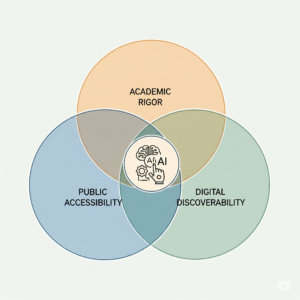
- Bridging the Knowledge Gap: By translating complex research into accessible, yet rigorous, narratives, AI-generated academic blogs make specialized knowledge digestible for broader audiences. This is crucial for public understanding of science, informing public policy, and fostering interdisciplinary collaboration.
- Global Reach and Accessibility: Digital platforms offer instantaneous global reach. An academic blog post can be accessed from anywhere in the world, breaking down geographical and institutional barriers to knowledge. AI can even facilitate multi-language versions, further expanding accessibility.
- Increased Citations and Collaborations: Greater visibility often correlates with increased citation rates. When research is more easily discoverable and understood, it is more likely to be cited in other works, both academic and non-academic, amplifying its impact. This also opens doors for new collaborations.
Case Studies and Emerging Applications
While the full impact of AI in academic communication is still unfolding, early applications demonstrate significant promise:
- Automated Literature Reviews: AI tools are being developed that can quickly compile comprehensive literature reviews on specific topics, identifying seminal works, emerging trends, and gaps in research. While requiring human refinement, this dramatically accelerates the initial stages of any research project.
- Synthesizing Conference Proceedings: Post-conference, AI can be used to synthesize key takeaways, discussions, and presented papers into cohesive, searchable blog posts or summaries, making the intellectual output of events more readily available.
- Explaining Complex Methodologies: For methodologies that are difficult to grasp for non-specialists, AI can generate step-by-step explanations or simplify technical jargon, making research methods more transparent and understandable to a wider audience.
- Personalized Learning and Research Feeds: AI can curate personalized feeds of relevant academic content based on a user’s interests and reading history, acting as an intelligent librarian that surfaces crucial new research.
The ethical considerations, such as attribution, potential for bias in training data, and the need for human validation, are paramount and form an integral part of responsible AI development in this sphere. However, with careful design and implementation, the benefits far outweigh the risks.
The Future of Academic Communication: A Symbiotic Relationship
The future of scholarly communication will undoubtedly be a symbiotic relationship between human expertise and AI efficiency. Hastylead, for example, represents a tool that empowers academics and institutions to leverage this synergy. By handling the heavy lifting of long-form content generation and image integration, it enables researchers to:
- Increase Publication Velocity: Accelerate the pace at which research findings are communicated to relevant audiences.
- Enhance Engagement: Produce visually appealing and highly readable content that captures and retains audience attention.
- Maximize Impact: Ensure that groundbreaking research is not only published but also discovered, understood, and applied by a diverse global readership.
- Reallocate Resources: Free up valuable human capital to focus on the core intellectual pursuits of research, experimentation, and critical analysis.
This shift signifies a move from mere publication to proactive, digitally-native dissemination, where the goal is not just to house knowledge but to actively project it, ensuring its maximal utility and influence across disciplines and beyond the academy. The automation of long-form, image-rich academic content is not a luxury; it is becoming a necessity for institutions aiming to remain at the forefront of global knowledge creation and impact.
Email: info@hastylead.com
Website: https://hastylead.com/
5. Discussion Question
“As AI and automation increasingly reshape academic publishing, what do you foresee as the single greatest ethical challenge in ensuring the integrity and authenticity of scholarly communication, and how can the academic community proactively address it?”